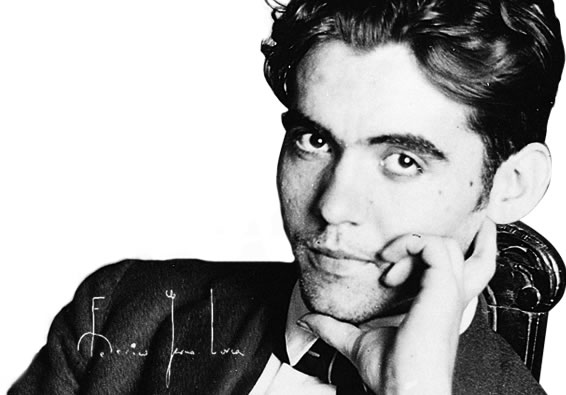

I wrote this response paper last year on Garcia Lorca and his theory of Duende, I am digging it up again to inspire me for my 25 page thesis, on poetry craft, I must write in order to fulfill the master’s degree requirement. The draft is due on April 15th, so chop, chop I go.
The Romancero Gitano ( Gypsy Ballads) is a book of poems by Federico Garcia Lorca, published in 1928. It’s made up of 18 ballads revolving around the topic of the gypsy life style, culture, and customs. The ballads reflect the pains of the gypsy people who live in the margins of society and are constantly persecuted by the authorities, and the fight against them and their repressive law. The ballads in this book are used for people wanting to learn Spanish and also many musicians and singers ( especially Flamenco) have used his ballads as their lyrics for their songs.
In Lorca’s, La Casada Infiel, (The Unfaithful Wife) is the only poem in the book written in the first person. The narrator of the story tells it as Don Juan would have done with all the bravado and machismo of a chivalrous gypsy.
La Casada Infiel is my favorite all time poem by Lorca, it is often recited in my family by memory. Lorca will always be one of my favorite poets not only because of who he was as a person, an amazing charismatic creative human being, who not just wrote poetry, but wrote plays and played the piano with excellence. I love him because he was a symbol of the brutality of the Franco regime. Last year, I saw a production of a play abut him and took my students. What I love also about him is that in this poem, he accomplishes what a good poem should accomplish: story, heart, poetic imagery that transports you there alongside with the narrator. Lorca’s skill in weaving a story of a maiden and a gypsy as well as his use poetic imagery, metaphor, assonance, personification, is what makes this poem par excellence.
Allow me to elucidate further, in the 2nd Stanza, Lorca sets up the reader to what is going on what is happening, pure sensual gratification, romance and mystery. As readers we are also left in suspense.
Fue la noche de Santiago
y casi por compromise
se apagaron los faroles
y se encendieron los grillos.
It was Santiago night
And almost out of duty
the lamplights turned off
and the dragonflies turned on.
I just love that stanza and Lorca’s use of personification is exquisite, musical, and memorable. He treats the lamplights and the dragon flies as if they are vigilant soldiers that set the scene for him and his lover, the maiden ( la mozuela). This stanza reminds me of French Lebanese poet, Venus Khoury Gata, who employs a certain use of personification that has become her trademark. In her book, which was translated by American poet, Marilyn Hacker, She says:
the earth is so vast one can’t help but be lost like water from a broken jug
There is no fortress against the wind
the winter wanderer must count on the compassion of walls
In Romancero Gitano, the poem, Romance Somnabula. I think of a sleep walker. Obviously it’s much better in the original language, Spanish and the translation pales by comparison. Even the meter and rhythmic tone is different in Spanish.
Just compare, “ Green how I want you green” to “ Verde que te quiero verde.”
There’s just a more pleasant and romantic quality in the Spanish versin. The repeated v’s roll smoothly through the line. The tone even sounds like the rolling hills where the soldier was galloping with his horse. Lorca paid attention to the musicality of the lyrics and the sing song quality the poem takes on, the English translation just can’t do this justice.
Federico Garcia Lorca first developed the aesthetics of Duende in a lecture he gave in Buenos Aires in 1933: Juego y Teoria del Duende (“Play and Theory of the Duende”). The duende Lorca refers to is mostly reflected in his work and poems in Poet in New York.
Duende belongs mostly to the realm of poets and singers, since it’s difficult to express this notion of duende in visual art or paintings. A wound that never heals appears in many mythic stories. Arthurian legend, Greek myth, Russian myth, Christian stories of stigmata, and many others seem to point to a universal story of suffering. Perhaps suffering and the writing that springs out of the attempt to heal it will evoke the duende. The duende, says Federico Garcia Lorca, is the battle pitched between you and death. It is a wound that won’t heal, a wind that blows over the dead, “a wind with the odour of a child’s saliva, crushed grass, and medusa’s veil, announcing the endless baptism of freshly created things.” From pain, violence or carnage, birth.
When I think of American Writers or Singers that possess “ duende”, I think of Patti Smith, Nina Simone, Amy Whitehouse, Leonard Cohen. When I think of World Music, I think of Manu Chao, The Gypsy Kings, Paco de Luca. Majority of the Spanish Flamenco Singers possess it and would not be called Flamenco without the subtle influence of duende in the rumbas and sevillanas. They affix us and transmit their duende to us.
El duende is the spirit of evocation. It comes from inside as a physical/emotional response to art. It is what gives you chills, makes you smile or cry as a bodily reaction to an artistic performance that is particularly expressive. Folk music in general has it, blues, tango, especially flamenco, tends to embody an authenticity that comes from a people whose culture is enriched by diaspora and hardship; vox populi, the human condition of joys and sorrows.
Drawing on popular usage and Spanish folklore, Lorca embodied the spirit of “ duende” in his book of poetry, Poet in New York. In a poem, Norm and Paradise of the Blacks. His poetry in this book take on a more bluesy and soulful quality, with repetitive themes of death, and sleepwalking as in his previous work, Romancero Gitano, Romance Sonámbulo. He writes: It’s through the blue without history,/ blue of a night without fear of day,/ blue where the nude of wind goes splitting/ the sleepwalking camels of the empty clouds.
In his poem, The King of Harlem, takes on the iconic Whitmanesque quality of Leaves of Grass.
Oh Harlem disguised! Oh Harlem, threatened by a crowd of headless suits! Your rumbling comes to me,/ your rumbling comes through trunks and elevators, through layers of gray/… / through your great desperate king,/ whose beard reaches the sea./ (33).
Although, I don’t think the translation does it justice. I really think you can’t read Lorca unless, you can read it in Spanish, what is the point, you’re wasting your time, in English, you only get a glimpse of the poet’s duende and vision for their poem.
What I will say of Lorca’s, Theory of Duende, is this, you can have style, you can have good looks, but if you don’t have duende you will never be able to capture an audience, whether it’s with poetry or with singing. To me, “ duende “ is that thing that makes you cry when you least expect it, you’ll be on a bus and reading a book of poetry and all of sudden, /the tear ducts do their acrobatics/ ( Sharon Olds) on your face, or, your washing the dishes and your listening to a song, and BAM, it hits you, the song opens up into tears. Sometimes it’s not all tears, it’s laughter that comes from your visceral or goose bumps and chills. The good poets that I have read in the last few months, like Olds, Gonzalez, Neruda, Baca, to me, they have “ el duende”, because one time or another, when I read them, I found myself, a grown, strong woman in control of my emotions, crying out of nowhere, as if the spirit touched me. Martin Espada says in his book, The Troubled Ball, in a poem, ( which I can’t recall at this moment) “ Poetry has the power to save us, somewhere a convict reads a poem from the prison library and sobs into his hand.” That’s exactly how I feel about “ duende” rich poetry: my religion, entertainment, education, all wrapped up into one ball.
Bibliography:
Theory and Play Of The Duende
Theory and Play of the Duende http://www.poetryintranslation.com/PITBR/Spanish/LorcaDuende.htm
The Unfaithful Wife- English Translation http://www.poetryfoundation.org/poetrymagazine/poem/242108
Two Poems by Federico García Lorca from “ The Gypsy Ballads”


Leave a Reply